
This article has also been published at The Newton Beacon.
Much has been going on in my life these past few weeks – mostly good things from which I harvest joy and connection. Some are small and personal, like hosting a get-together of neighbors, or attending a huge, fun event where one of my daughters-in-law performed with her luminous pop-band.
Then there are large and impactful happenings like those in response to the sinister time in which, unbelievably, we are living each day. On March 28, I went to the No Kings rally in Newton Centre. An estimated 2,500 people showed up with scores of signs boldly expressing resistance to our national regime. I use the word ‘regime’ purposefully, because we are scared about autocracy. Terrified may be a better word.
Home-made signs shouted against cruel anti-immigration practices, brutal ICE actions, assaults on the US Constitution, degradation of the environment, and inhumanity. Fervent speakers urged action to resist tyranny.
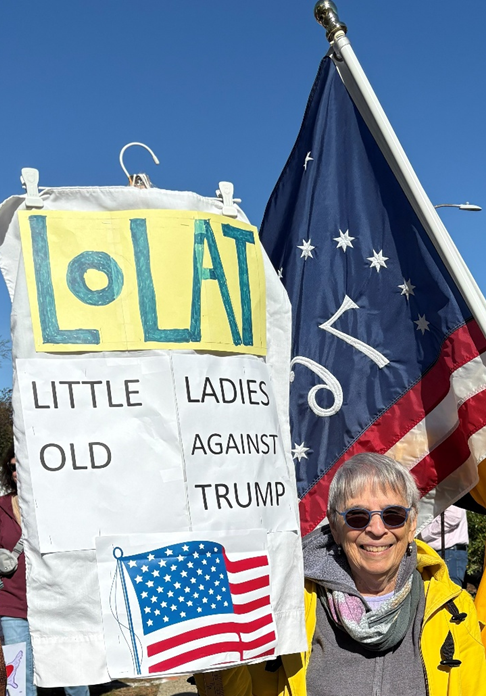
There were lots of us bundled up there on that cold (but sunny) March day to express our beliefs and values. We carried signs and listened to orators. I brought my own sign. It read “LOLAT (Little Old Ladies Against Trump). Attendees of all ages, genders, and ethnicities chuckled when they saw my sign, and some took pictures. Some said emphatically, “that’s who I am – a LOLAT!”
I first brought my LOLAT sign to the Newton No Kings rally in the fall of 2025 and I got the same encouraging reactions. On that day, I was the only one with a LOLAT sign, which I made from an old pillow case. This time, I was joined by a friend who had also made a LOLAT poster. On the South Shore, another friend went to a rally in Plymouth with her own LOLAT sign.
Now there were three of us. A couple of individuals at the No Kings rallies have balked at the name, telling me they felt that ‘little old lady’ was a derogatory term for older adults (formerly called “seniors,” “elders,” or “senior citizens”). I see the LOL designation as a feisty, fearless way to recognize the incredible knowledge, experience, and, yes, power that we older people have. We exemplify and demonstrate these qualities when we turn up and stand up for sanity, and liberty.
I looked around at both the fall and spring events, and took note of who was there. There were many different groups – kids, teens, young adults, and middle-agers. But the vast majority were elders – call us whatever you like. Demographics affirm that in the United States, each elder is a tiny segment in a huge cohort that is over the age of 65.
That cohort numbered an estimated 61 million to 64 million nationally in 2024 to 2025. In suburban Newton, we’re roughly 18 percent of the population, 16,000 to 17,000 residents. Urban Boston is somewhat younger, with residents over 65 numbering more than 82,000, about 13 percent of the population. Boston’s No Kings rally drew an estimated 180,000 participants, and an estimated 8 million protested at thousands of sites nationally, an historic record.
Tucked into these busy times was our family Passover seder. We were a small group of celebrants of young, old, various genders, different ethnicities, and diverse religious and spiritual traditions. We sat together to re-tell and reimagine the story of the Exodus from Egypt.
Each year I find new ways to think about the messages embedded in this ancient recounting of cruelty, oppression, and ultimate escape. This compelling, time-resistant story comes from more than three thousand years ago. It is poignantly relevant today. We use a contemporized Haggadah (a text that means ‘the telling’).
In the passage describing what happened when the fleeing Israelites reached the shore of the Red (or Reed) Sea) there was no way to escape. Then, one courageous person stepped into the shallows. That one step triggered the waters to part, revealing a path into freedom.
This passage made me understand that taking one step into a fraught, frightening unknown was the critical factor in creating a future full of dignity, safety, and hope. I continue to determine the steps I must take to pursue those fragile goals. They reflect who I am as a caring member of humankind.
Great essay Marian, as always one that is inspirational and a joy to look forward to!
I didn’t join you at the last No Kings Rally, but I did attend the one in Palm Beach with my daughter!
We marched, with a very large group up The Southern Boulevard Bridge that leads right up to
Mar-a-Largo! 80% of the way to Trump”s property, a police barricade was installed to keep us away.
White House reporter Alex Traynor was covering the protest and it was shown on tv on all the channels.
It was an exciting evening for my daughter and me and we were amazed at the number of people attending with fabulous home made signs. One sign was posted on a gold painted toilet seat!
Love and hugs,
Ellie
Ellie, So great that you were at the No Kings rally in Palm Springs! We LOLATs are all over the place!!
If you had something to write on the golden toilet seat, what would it be? I will think about that also.
Marian: Go Lolat!! I got chills up my spine reading your essay! Dignity, safety, and hope for all
Carolyn, Thanks a million. Yes, it was a great turnout in Newton Center. And, to reiterate, the majority of people there were older. We ‘elders” (or whatever we want to call ourselves) have the power and the numbers to make an impact!
Les, What a great response! We need to keep those spinal chills and going!
Marian.
Enjoyed your latest. Yes I was at the kings rally too.. A great turnout.. Nice article..Keep them coming
Carolyn
Awesome, as always. We hadbthecrally in Gloucester too andvthe majority were white haired women
How do we get the younger n ones involved? I try but….
Which daughter in law is in a pop band? So cool!
The world is a mess and I dail to understand how this demented warmongering lunatic pedaphile rapist is still in power. We have become everything we fought against.
Need to see you soon! You are an inspiration, as always. Much love, Donna
Donna,
Great comments. Yes, the people who are showing up are those with gray hair. Younger people may be more prominent in bigger cities. I guess I think that we need more and more older people to step out and step in. We are a terrific potential power.
I’ll fill you in on the pop band!